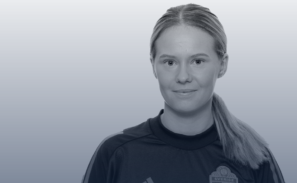




Lovisa Bergvall’s journey in football started at age five, playing for IFK Lidingö. With no football background in her family, she quickly developed a passion for both competition and leadership. At 13, she stepped into her first coaching role as a youth leader duringsummer camps, and at 18, she hung up her boots to fully embrace life on the sidelines.
– I naturally transitioned into coaching when I stopped playing. I liked taking responsibility on the pitch, and I liked talking – both during games and in the locker room. Coaching felt like the right next step, says Bergvall.
She spent several years in different roles within IFK Lidingö’s academy, coaching both boys and girls, before becoming assistant coach for the club’s women’s team. In 2024, after 17 years with the club, Bergvall decided to take on a new challenge.
– I had a great time at IFK Lidingö, but I felt ready for something new. So when Trelleborgs FF approached me ahead of the 2025 season, it felt like the right next step.
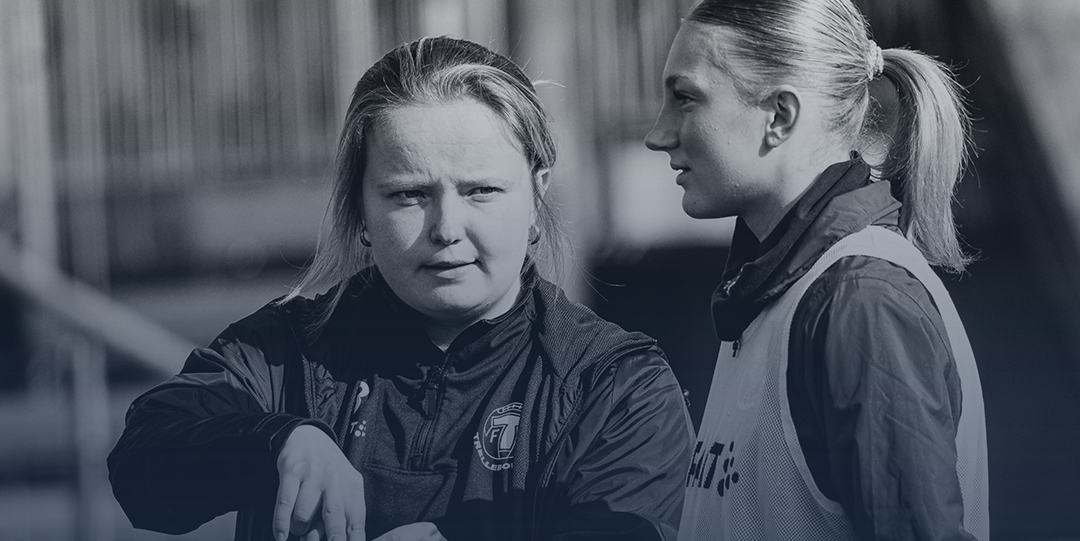
Today, she is assistant coach for TFF’s women’s first team and head coach of the G17 Academy team and as a key link between youth and senior football.
How did your coaching path take shape?
– From the start, I wanted to gain an as broad experience as possible. I’ve coached both boys and girls, youth and seniors, and I’ve always tried to learn from people who think differently than I do. Those discussions have taught me the most – both in terms of football and leadership.
What inspired you to become a coach?
– It mostly comes down to my love of football. I’m a football nerd, and I like to talk. I’ve also always found rhetoric and group dynamics fascinating, and I’m inspired by people who are skilled leaders.
What qualities do you consider most crucial to being a successful coach?
– Leadership, without a doubt. It’s a cliché, but it depends on how you define it. For me, it’s about understanding the psychology behind why players act and perform the way they do. If you want to change a behaviour sustainably, you need to understand where it comes from—and that starts with creating a safe environment where players feel comfortable talking to you and to each other.
– I also believe it’s crucial that everything you do on the pitch has a purpose. Whether it’s a match plan or the distance between two cones in a drill, there needs to be a reason. Otherwise, you’re always leaving part of the development—or the result—up to chance. And I have no interest in that.
What challenges do you usually face in your work as a coach, and how do you deal with them?
– The biggest challenge is dealing with setbacks—both my own and the team’s. It’s easy to lead and perform when things are going well, but it’s during adversity that your leadership really gets tested.
What is your goal as a coach?
– I always strive to be the best in whatever role I have at the time. This year, that means I want to be the best assistant coach in Elitettan. It’s not a goal you can measure precisely, but for me it’s about the drive to become as good as I possibly can.
What is your vision for yourself and for women’s football in general?
– Personally, I want to work in elite football for many years to come. I want to keep building experience and go as far as I can. On that journey, I want to make sure the players I coach enjoy football. If they don’t have fun, it will be hard to create development and results.
– For football in general, I want to reduce the gap between men’s and women’s football in every aspect—from financial conditions to participation rates. We still have a way to go, but if you look at the past ten years, a lot of positive things have happened.
What needs to be done to bring out more female elite coaches?
– I think we need to blur the lines between men’s and women’s football. There are more women coaching girls’ and women’s teams now, but female coaches for boys and men are still rare. That limits job opportunities.
– To me, gender is irrelevant. The most qualified coach should get the job—regardless of whether it’s a man coaching women or a woman coaching men.
The interview was created through the project Elite Coaching Pathway in collaboration with EPOS, Sundström Safety and Akea.