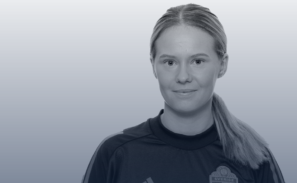






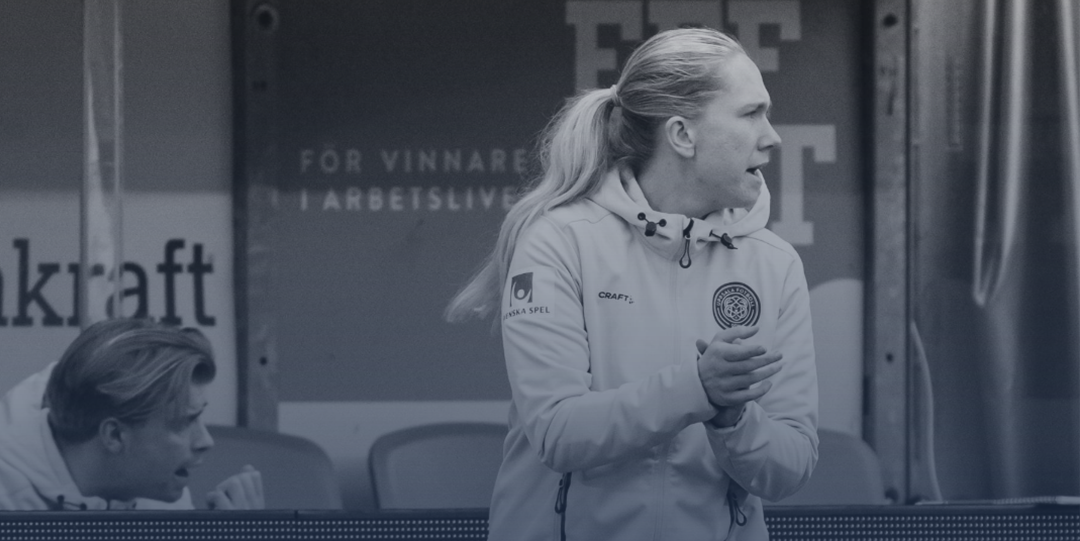
After a playing career that spanned across the United States, Greece and Sweden, Hanna Spets was forced to retire at the age of 24 due to recurring knee injuries. Despite that, she wasn’t ready to leave the sport behind.
– Several of my former coaches encouraged me to continue in football as a coach. That was the start of my new path, says Hanna Spets, now head coach of IK Uppsala Fotboll in Elitettan.
Hanna Spets grew up in Karlstad and began playing in the local grassroots club Skattkärrs IF before moving to the elite environment at QBIK. She later combined business studies with collegiate soccer in the United States, followed by playing professionally in Greece, before she returned to Sweden and played for clubs in both OBOS Damallsvenskan and Elitettan. She ended her career at Kvarnsvedens IK at just 24 years old.
During her transition from player to coach, she took her first steps on the sideline in Kvarnsvedens IK and enrolled in several coaching courses.
– In 2022, I decided to go all in and moved to Uppsala to coach in IK Uppsala Fotboll. Over the years, I’ve had the privilege to work in various roles within the academy. Now in my third year at the club, I’ve taken the step to become head coach of the first team.
Who or what inspired you to become a coach?
– When I was 16, I had two female coaches, Therese Lückner and Lisa Mellberg. They showed me that there was a different kind of career path within football. I’ve always had a passion for helping others develop and I realized early on that I enjoyed analyzing the game and following other players’ progress. It’s incredibly rewarding to see someone take steps forward and knowing that you were a small part of their journey. My family and friends have also been key in encouraging me to pursue this path.
What qualities do you consider most crucial to being a successful coach?
– To me, successful leadership is about combining being transparent and creating a structure with empathy and attentiveness. A good coach is someone who sets clear boundaries and goals, but who also sees the person behind the player. I believe in taking the time to get to know every player, so that I can create an environment where they feel encouraged to grow.
– Another essential quality is being humble – both to be open to feedback and to remain on a journey of continuous growth. It also helps me stand tall in who I am as a coach today, and who I hope to be remembered as.
What challenges do you usually face in your work as a coach, and how do you deal with them?
– A recurring challenge is managing different personalities and expectations within a group. Players come from different backgrounds and experiences, so aligning their expectations with the team’s framework requires a massive effort. Another challenge is playing time – making sure players who get less time on the pitch still feel included and important.
– Both challenges come down to communication. It’s about being clear with expectations, both individually and collectively, and maintaining an open dialogue.
What is your goal as a coach?
– One of my long-term goals has been to further my coaching education, which I’m fortunate to now take part in an UEFA A-course. I have a clear plan for my coaching career and have already taken important steps in the right direction. As of now, my focus is on developing my coaching qualities and strengthening my identity as a coach. I want to build a stable and professional foundation to grow from, with the ambition of taking on more advanced roles in the future.
What is your vision for yourself and for women’s football in general?
– I want to continue developing, both professionally and personally, and work in an environment with forward-thinking colleagues, where I can contribute to others’ growth. I’m determined to stay in football long-term: coaching isn’t just about my own journey – it’s just as much about creating opportunities for players to dream big and reach their goals.
– For women’s football, my vision is continued growth – not just in popularity, but also in professionalism, resources and respect. I hope to look back one day and say: women’s football is better now than ever before.
What needs to be done to bring out more female coaches at the elite level?
– It’s a complex question, but a big part of it is seeing coaching as a possible career path. It demands time, dedication and decisiveness – like many other careers – but if you’re willing to invest the time and it gives you more energy than it drains, it’s worth it.
– We also need to highlight the career opportunities within football beyond the playing career. Clubs, educational institutions, and the media all have a role in making coaching visible and attractive. As football grows and becomes more professional, I believe we’ll see more female elite coaches. With the right support, encouragement and clear career pathways, that development can only accelerate.
The interview was created through the project Elite Coaching Pathways in collaboration with EPOS, Sundström Safety and Akea.